 Retatrutide-Peptide.biz
 Written by Eric J. Topol, MD
 Reviewed by Ania M. Jastreboff, MD, PhD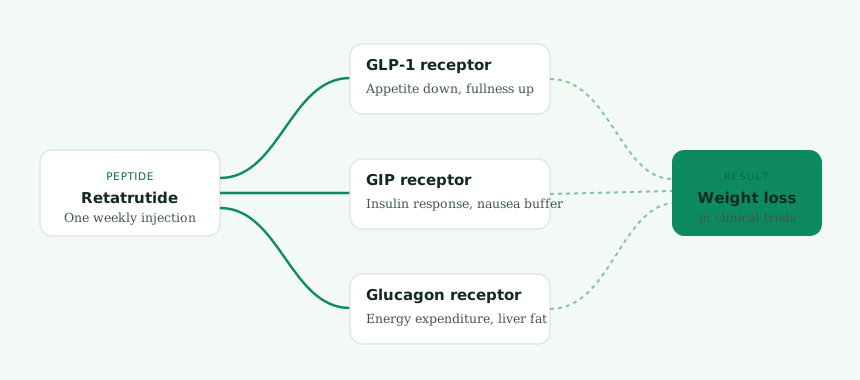
So what is retatrutide, exactly? Retatrutide is an investigational peptide, given as a once-weekly injection, being studied as a treatment for obesity and related metabolic conditions. It belongs to the same drug class as familiar GLP-1 medications, but it acts on three hormonal pathways simultaneously rather than only one or two. In simple terms, retatrutide is a synthetic molecule designed to mimic multiple hormones that control appetite and metabolism, reducing hunger, slowing stomach emptying, and influencing how the body uses and stores energy. It's important to state upfront that retatrutide is not FDA-approvedWithin the US, it is available only as a compounded medication from a licensed pharmacy, prescribed under the supervision of a healthcare provider, and should never be obtained on one's own or used without medical oversight.
Because it is still being investigated, most knowledge comes from mid-stage trials rather than routine use. This article explains plainly what the drug is, how it works, how it is classified, and which patient groups researchers are focusing on.
What effects does retatrutide produce, and why is it called a triple agonist?
Understanding how retatrutide works begins with the hormones it targets. Most current weight-loss injectables are single or dual agonists. A single agonist, for example semaglutide attaches to only one receptor (GLP-1). A dual agonist, like tirzepatide, activates two (GLP-1 and GIP). Retatrutide goes a step further as a triple agonist that engages three receptors at once: GLP-1, GIP, and glucagon.
Simplifying the three targets
GLP-1 (glucagon-like peptide-1)
This signaling pathway reduces appetite, slows gastric emptying, and helps with blood sugar control after meals. It is the main driver behind many modern weight-loss medications.
GIP (glucose-dependent insulinotropic polypeptide)
GIP works together with GLP-1 to boost insulin response and may improve how the body handles fats and sugars. The added GIP activity is what sets dual agonists apart from single ones.
Glucagon receptor activity
This is the element that truly makes retatrutide a triple agonist. Activation of the glucagon receptor may increase energy expenditure (roughly, the calories burned while at rest), potentially adding an extra metabolic boost on top of appetite reduction. This third mechanism is why some informally call it a GLP-3 or GLP3 retatrutide agent, though 'GLP-3' is a popular nickname, not an official receptor name.
Step-by-step: How retatrutide works
The retatrutide mechanism of action combines appetite suppression with a possible metabolic boost. Here's how researchers describe its potential effects in the body over a course of treatment. It's worth noting that retatrutide isn't the only option; our comparison of next-generation metabolic peptides sets it alongside tesamorelin, survodutide, and the amylin analogs.
It mimics natural gut hormones
After injection, the peptide binds to GLP-1 and GIP receptors, signaling the brain and digestive system to reduce hunger and heighten feelings of fullness after eating.
It slows digestion
By slowing stomach emptying, food stays in the stomach longer, which may help a person feel satisfied with smaller meals and reduce total calorie intake.
It activates the glucagon pathway
Activity at the glucagon receptor may raise resting energy expenditure and influence how the liver processes fat—a mechanism thought to contribute to the substantial weight reductions seen in clinical trials.
It supports blood-sugar regulation
The combined actions of GLP-1 and GIP can improve glucose management, which explains why researchers are also studying it in people with type 2 diabetes.
The combined effect seen in trials is a reduced appetite along with a possible rise in energy expenditure. More details can be found about the specific weight-loss results reported in clinical research on our dedicated page.
How is retatrutide classified, and is it a peptide?
A common question is whether retatrutide counts as a peptide. Yes, retatrutide is a synthetic peptide, meaning it is a chain of amino acids designed to bind specific hormone receptors. So when people ask "what is retatrutide peptide," they are correctly describing its chemical nature: it is an investigational peptide-based drug, not mainly a small-molecule pill.
Does retatrutide count as a GLP-1 medication?
Many people ask whether retatrutide is a GLP-1. The correct answer is: partly. It does bind to the GLP-1 receptor, so it shares that mechanism with drugs like semaglutide. But calling it simply "a GLP-1" understates it, since it also targets GIP and glucagon receptors. More accurately, it is described as a triple agonist that acts on GLP-1, GIP, and glucagon instead of a pure GLP-1 drug.
| Agonist type | Receptors targeted | Example |
|---|---|---|
| Single agonist | GLP-1 | Semaglutide |
| Dual agonist | GLP-1 + GIP | Tirzepatide |
| Triple agonist | GLP-1, GIP, and glucagon together | Retatrutide (investigational) |
If you are weighing options, our analysis of retatrutide vs tirzepatide explains how the triple agonist differs from the dual agonist in mechanism and reported outcomes.
Retatrutide's half-life and the reason for weekly dosing
The half-life of retatrutide is around six days, which is why it is studied as a once-weekly injection. This longer half-life keeps the drug active in the body long enough to maintain a steady effect between doses, so trial participants typically inject just once every seven days rather than daily.
Why the dosing schedule is increased gradually
In clinical trials, retatrutide is not started at the full dose. Instead, the dose is raised slowly over several weeks (a process called titration) to let the body adjust and to reduce the risk of nausea and other gastrointestinal side effects. This stepwise approach is common for drugs in this class. You can find a general outline of how the weekly dosing schedule is typically arranged for more specifics on titration steps.
Who makes retatrutide, and what versions exist?
Retatrutide is developed by Eli Lilly and Company, the same company behind several well-established metabolic treatments. As of now, it remains investigational and is in late-stage clinical trials; it has not received FDA approval, and no branded or approved version can be prescribed. This distinction is crucial for anyone researching the retatrutide drug: what you might encounter in the US is a compounded preparation, not an FDA-approved commercial product.
Compounded retatrutide versus other forms
Compounded retatrutide is the medication when it is made by a licensed compounding pharmacy for a specific patient with a valid prescription. Since the injectable peptide is the form most studied, compounded versions are usually given as a weekly subcutaneous injection.
What about oral retatrutide?
There is common interest in an oral retatrutide because a pill would be more convenient than an injection. However, peptides are generally hard to give orally, and most research so far has focused on the injectable form. Any oral claims should be treated with caution, and a licensed provider is the best person to confirm what is legitimately available.
Comment on safe sourcing
If you and your clinician decide this path is suitable, the medication should only come through legitimate channels. Find out how to access retatrutide via a licensed provider and pharmacy rather than from unverified sellers.
What is retatrutide used for in research settings?
When people ask "what is retatrutide used for," the correct answer is that it is being investigated (not yet approved) mainly for chronic weight management in adults with obesity or overweight, and for related conditions like type 2 diabetes. Researchers have also examined its effects on metabolic markers and fatty liver. In its most referenced phase-2 study, those on the highest dose experienced a mean body-weight reduction of up to roughly 24% at 48 weeks; these are trial figures from the research literature and should not be taken as a guarantee of individual results, which vary widely and depend on many factors.
Because retatrutide is still investigational, it should only be used under a structured program that includes diet, physical activity, and monitoring for adverse effects. Anyone considering it should review the complete situation, including potential side effects reported during treatment with a qualified healthcare provider before beginning.
Frequently asked questions
How would you explain retatrutide in plain language?
This is a peptide synthesized in a laboratory that is presently being studied and administered as a weekly injection. Its mechanism involves imitating multiple hormones that regulate appetite and metabolism. Research into it focuses on weight management, and it has not been approved by the FDA.
Is retatrutide merely a GLP-1 drug, or does it offer more than that?
It binds to the GLP-1 receptor, but it additionally acts on GIP and glucagon receptors, making it a triple agonist. Therefore, describing it only as a GLP-1 medication is not accurate.
What does the nickname "GLP-3 retatrutide" refer to?
"GLP-3" is an informal label some people use because retatrutide targets a third receptor alongside GLP-1 and GIP. It is not an official receptor designation.
What is retatrutide's half-life, and what is its dosing schedule?
Its half-life is roughly six days, which is why it is investigated as a once-weekly injection, typically with a stepwise dose increase under medical supervision.
Does compounded retatrutide match an approved medication?
Absolutely not. Compounded retatrutide is prepared by a licensed pharmacy for an individual patient. Because no FDA-approved commercial version exists yet, careful oversight by a licensed provider is required.
Who makes retatrutide?
Retatrutide is developed by Eli Lilly and Company and remains in late-stage clinical trials as an investigational drug.
Sources & references
Claims of fact on this page are checked against the primary literature and regulators below. See our editorial standards.
- Jastreboff AM et al. Triple-Hormone-Receptor Agonist Retatrutide for Obesity: A Phase 2 Trial. New England Journal of Medicine 2023;389:514-526. View source
- The same phase 2 trial is recorded on PubMed (PMID 37366315). View source
- ClinicalTrials.gov: TRIUMPH-1 (NCT05929066), a phase 3 study of retatrutide for obesity or overweight. View source
- NIH / NIDDK: Prescription Medications to Treat Overweight & Obesity. View source
- US FDA: Human Drug Compounding Laws (sections 503A and 503B). View source